
🐾Animals Caught in the Crossfire: War’s Unseen Victims and Unlikely Heroes

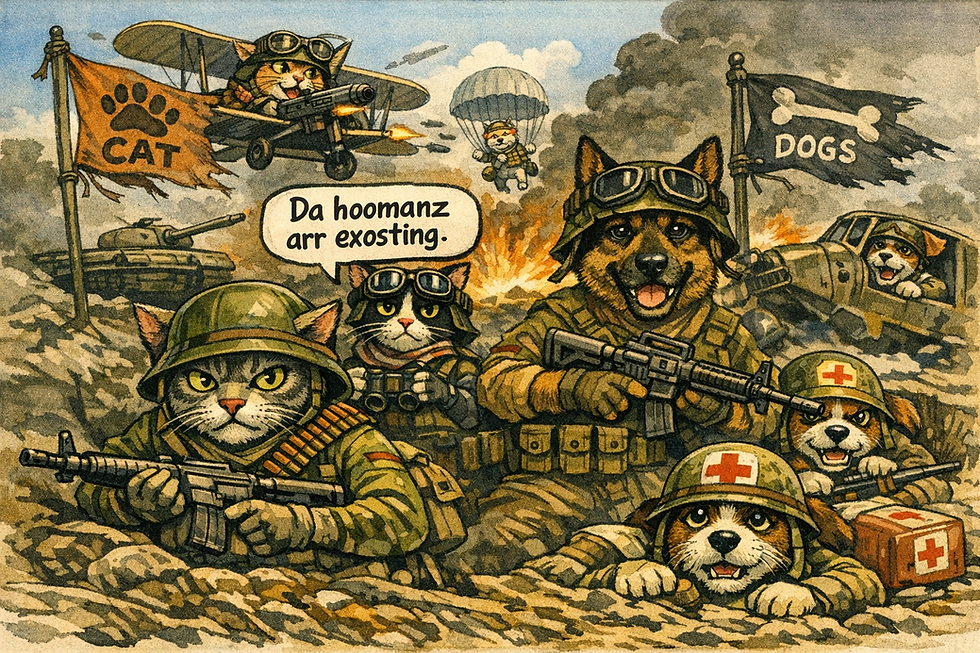
From drone cables in Ukraine to marine life in Malta — conflict shapes the fate of our fellow creatures
War drags everything into its orbit—landscapes, civilians, infrastructure, and yes, animals. Not just as symbols or mascots, but as working bodies, collateral damage, and sometimes the only ones with common sense amid chaos.
Some are conscripted. Some adapt. Most try simply to survive the turmoil we create. In modern conflicts, the ways animals are affected are evolving faster than the headlines can keep up.
🦦 Wildlife in Ukraine: The New Threat No One Saw Coming — Fibre Optic Drone Cable
Modern drone warfare has introduced an ecological hazard that didn’t exist a decade ago: kilometres of fibre optic cable draped across fields, forests, rivers, and towns.
Both sides now use drones tethered by ultra-thin fibre optic lines to avoid electronic jamming. After each one-way mission, the cable is simply abandoned.
What’s Happening on the Ground
Lyman frontline cities are blanketed in translucent fibre optic wire from hundreds of drone sorties.
The cable is nearly invisible, extremely strong, and accumulates fast—a single drone can trail 5–20 km of polymer fibre.
Forests around Kupiansk and fields near Pokrovsk show the same pattern: invisible nets laid over entire landscapes.
Why This Is Catastrophic for Wildlife
Entanglement: Birds, bats, foxes, deer, and small mammals become trapped in the strands.
Movement barriers: The cables act like “fences in the sky,” blocking access to habitat, water, and feeding grounds.
Microplastic pollution: As the fibres degrade, they release microplastics into soil and waterways and get dispersed by birds using it as nesting material.
Demining complications: Tangled cable makes post-war clearance slower and more dangerous.
This is the first conflict in history where communication infrastructure itself becomes a wildlife hazard, and the scale is unprecedented.
⭐ Heroic Animals — and the Ones Who Became Heroes by Staying Home
Wartime storytelling often elevates individual animals into icons. Some performed extraordinary tasks under impossible conditions; others became national mascots just for being in the right place at the right time.
The Genuine Heroes
Cher Ami, the pigeon who delivered a critical message despite being shot and losing a leg.
Sgt. Stubby, the dog who warned soldiers of gas attacks and located the wounded in no-man’s-land.
Reckless, the mare who carried ammunition under fire and evacuated wounded Marines in Korea.
Voytek, the bear who carried artillery crates and boosted morale in a Polish WWII unit.
The Accidental Heroes

Simon the Cat, decorated for catching rats on a naval ship.
Wojtek-adjacent mascots, who became legends without lifting a crate.
Man-o-War, the race horse who rose to fame on his owners contribution to the war and being a racing chap
Regimental goats, donkeys, cats, and dogs who were mascots mythologised as wartime influencers.
Their “heroism” was often just existing near soldiers who needed money or a symbol of normalcy, luck, or home.
Why This Matters
We project meaning onto animals to cope with chaos and justify their sacrifice.
We elevate them to simplify complex events.
We use them as emotional anchors in environments designed to strip people of humanity and stability.
Some animals genuinely performed remarkable tasks. Others were swept into the narrative machinery of war, becoming symbols or morale boosters without ever consenting.
🦬 Marine Life: Swimming Under the War
Marine life is disrupted by war overhead. Ships and submarines create immense sound pollution and sometimes chemical pollutants. Explosions add shock waves throughout the water column.
Sound pollution disrupts communication, which in turn affects mating and migration. Chemical leaks from targeted vessels threaten marine ecosystems. The Russian vessel drifting outside Malta is just one example of a floating risk.
War doesn’t need to be on your doorstep to throw nature into chaos.
🐕 Dogs: Drafted Into Human Chaos
Dogs aren’t “born heroes.” They’re useful because they can smell, track, carry, comfort, and alert when everything else is falling apart. War hijacks those instincts and puts them in harm’s way.
They’ve been messengers, sentries, search‑and‑rescue workers, and emotional stabilisers. They don’t understand geopolitics—just people and routines.
🐕 Pets and Zoo Animals Stranded by Evacuations and Broken Food Chains
At conferences we hear the heroic stories of people helping animals in conflict-effected regions. Animals are often left to fend for themselves in gut wrenching situations that drive people to difficult choices and decisions they never asked for.
🐎 Horses, Mules, and Donkeys: The Transport Corps That Never Retired
Even in the age of drones and satellites, equines remain essential in terrain where engines choke. They’ve pulled artillery, carried supplies, and evacuated the wounded.
Their survival has always depended on whether the humans handling them understood their limits—history is full of both competence and catastrophic ignorance.
🐘 Elephants: Intelligence Pressed Into Service
Elephants were historically used as living machinery—transport, demolition, intimidation. None of it suited their psychology or social structure. Their “performance” in war says more about their tolerance than compatibility.
🐀 Rats: The Opportunists
Rats don’t join wars; they exploit the conditions. Trenches, rubble, abandoned food stores—perfect habitat. Their presence is a biological audit of infrastructure collapse, not a moral failing.
🌍 The Bigger Picture: War Rewrites Ecosystems
Across conflicts, wildlife suffers in ways that rarely make headlines:
Habitat fragmentation
Noise trauma
Chemical contamination
Disrupted migration
Long-term population collapse
Ukraine’s fibre optic debris crisis adds a new chapter—one where modern warfare creates synthetic, persistent hazards that behave like invisible snares across entire landscapes.
🧭 A Final Note
We cannot afford to look away.
Staying silent means letting war persist to “settle” conflicts; that doesn’t resolve anything—it just stockpiles more work for the future and loads more unnecessary hardship onto animals who never had a say in any of it.
War is perhaps the single biggest overarching threat at present with far and wide reaching consequences.


Comments